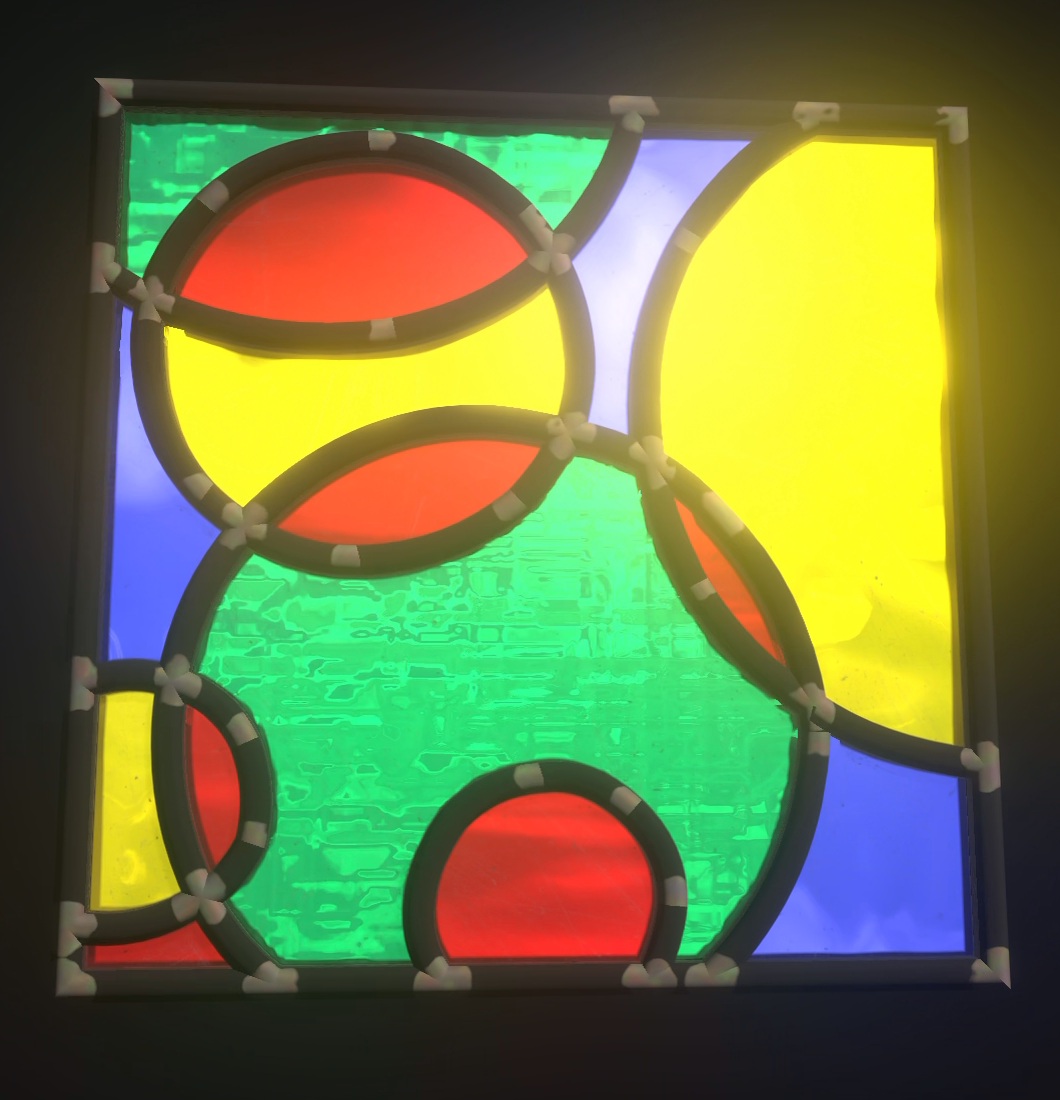
 GLASSA stained-glass puzzle game with a tactile editor, a responsive musical score and a custom C++ geometry system.GodotGDScriptC++View case study
Games
Fun with Theorems
What the Four Colour Theorem gives a puzzle game, and what it leaves to the designer.
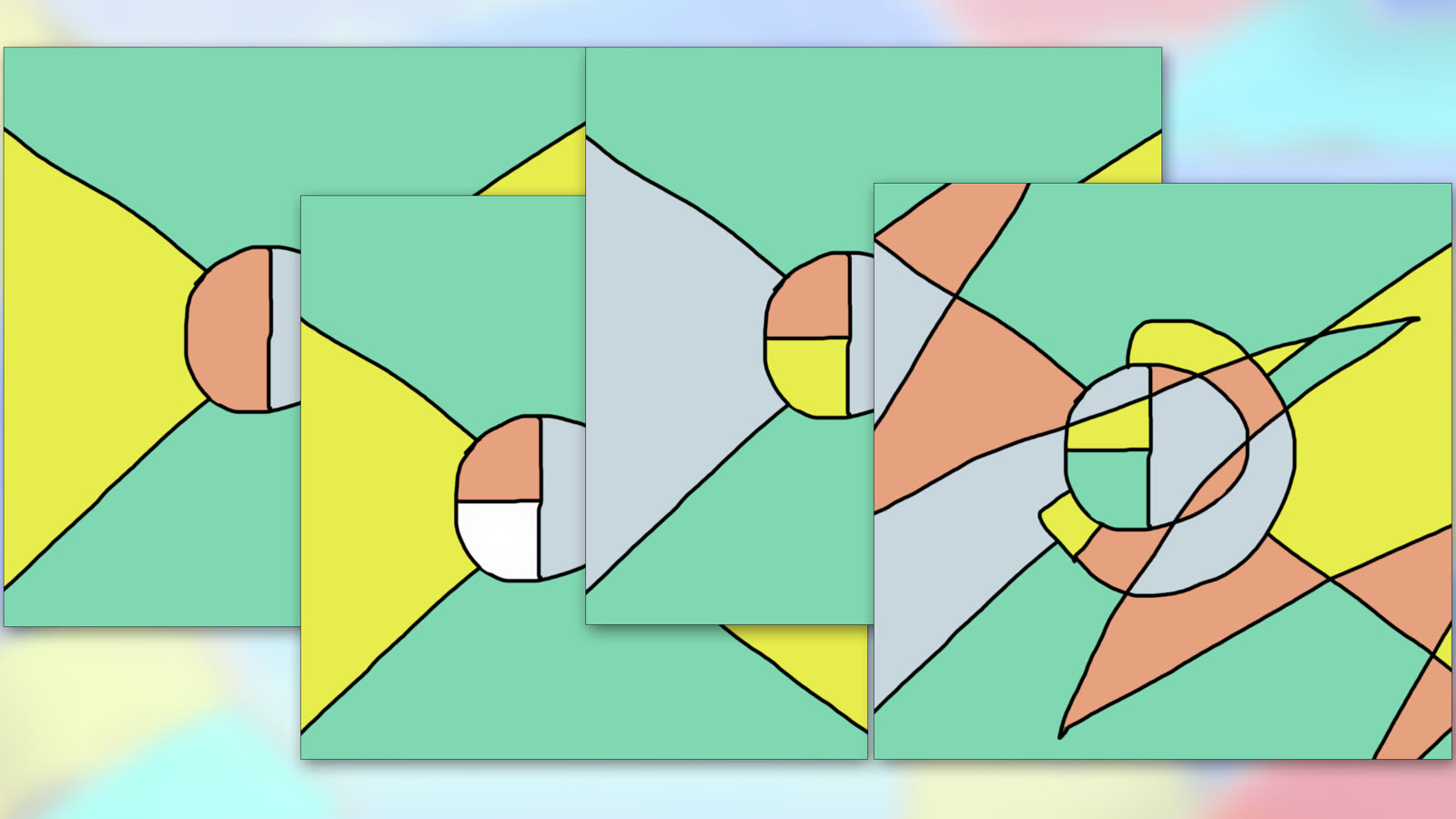
The useful starting point for GLASS is that a planar map can be coloured with at most four colours so that regions sharing a boundary use different ones. Meeting at a single point is not the same as sharing an edge.
That gives the game a simple rule, but it does not design a satisfying puzzle. It also does not guarantee that a drawing will be readable, or that extra restrictions will leave the player a solution.
The rule and the drawing
A mathematically valid region can still be a poor thing to ask someone to colour on a phone. A narrow gap or a tiny sliver can make the neighbour relationship hard to see.
That is why the editor has spacing and junction constraints in addition to the colouring rule. The geometry needs to communicate the problem to a person, not just supply a graph to the game.
Rules I tried
Earlier experiments added pressure in several ways: a timer, locked colours, a queue of colours and restrictions on which region could be chosen next.
They did not all preserve the useful freedom of the starting rule. Locked colours, for example, require care: the existence of some four-colouring does not mean every partial assignment can be completed. A forced sequence can create a different problem again.
Those experiments helped me distinguish between difficulty that made the puzzle interesting and restrictions that simply made the player work around the interface.
Where the game went
The clearest later influence was public playtesting. At EGX people repeatedly described GLASS as relaxing. I moved the design towards that response rather than keeping the timer as a necessary part of the game.
This updates my earlier account, which considered timed and more restrictive modes. They are part of the design history, not a statement of the current release plan.
There is also a correction to the old technical framing: computer four-colouring is not limited to brute-force search. Published algorithms exist, including a quadratic-time algorithm described by Robertson, Sanders, Seymour and Thomas. That question is separate from finding a colouring puzzle enjoyable.
Related project
See the work behind this post.
GLASSA stained-glass puzzle game with a tactile editor, a responsive musical score and a custom C++ geometry system.GodotGDScriptC++View case study